Erik wrote r – and the district followed
Around Enköping, words such as æftiᛦ are written with an ordinary r instead of the old yr-rune ᛦ five times as often as in the rest of the country. Was it the local pronunciation? The traces lead to a carver, Erik, who wrote r on every stone, and to the carvers after him. We think the spelling was a writing tradition, not a spoken one.
Hjalmdís and Þorsteinn raised these stones in memory of Nokki. Æirikr cut.
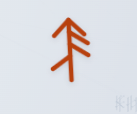
So it reads on a runestone at Rotbrunna in Härnevi parish, between Enköping and Sala. The carver's name comes last, and he writes it airikr. The last sign is an ordinary r. But in his language the name ended in a special r-sound, which had a rune of its own: ᛦ. Erik never used it. Not in his own name, and not on any of the fifteen stones securely attributed to him where such a word can be read. And in his district it became common to write that way.
A sound on its way out
The younger futhark had two r-runes. One, ᚱ, stood for our ordinary r. The other, ᛦ, stood for an r-like sound that had developed from an older z. Scholars render it as R when they write the runes in Latin letters; here we show the rune itself. The sound occurred above all at the ends of words: æftiᛦ (after), þæiᛦ (they), stæinaᛦ (stones) and in names such as Æirikᛦ. During the Viking Age and the early Middle Ages the two r-sounds merged in pronunciation. How the yr-rune was used and what it stood for in the Scandinavian runic inscriptions has been studied by Patrik Larsson in his dissertation (2002). But whether the spelling in a single district followed the district's pronunciation, or the carver's habit, is another question.
We went through the 938 Swedish runestones where at least one word ending in ᛦ can be read, and counted how often it is written with an ordinary r. That happens on 16 % of the stones. But not evenly.
A district that writes r
Stones with r for ᛦ stand near each other more often than chance would give, and they gather especially in western Uppland, in the parishes around Enköping: Vårfrukyrka, Simtuna, Löt, Villberga and Husby-Sjutolft. Within 22 kilometres of Grop-Norrby in Vårfrukyrka, 32 of 52 stones have the spelling, that is 62 %. In the rest of the country it is 12 %. The spelling is almost 5 times as common in the district.
The scale runs from 0 to 60 %. Source: Vitki's corpus analysis of the Scandinavian Runic-text Data Base; stones where at least one word ending in ᛦ can be read.
The further from the district, the rarer: from 53 % closest to 18 % twenty to fifty kilometres away and about a tenth further off. It looks like a dialect boundary. But is it one?
The district's speech or the carver's hand?
There are two explanations, and they make different predictions.
The district's speech. If the ᛦ-sound had disappeared from pronunciation in western Uppland, the carvers wrote as people there spoke. Then every carver working in the district should write r more often there than elsewhere, and the same carver should write ᛦ more often when he cut stones for patrons in other districts.
The carver's hand. If the spelling was the habit of a carver or a workshop, it follows the carver and not the place. Then the carver should write r wherever he carved, and other carvers in the district should not.
Erik
The answer begins with a carver. Fifteen stones with legible ᛦ-words are attributed to Erik with certainty in Rundata, and on all fifteen he writes r. Thirteen stand in the district. The two that stand outside it – at Uppsala and in Vittinge – have the same spelling. Erik wrote aftir, never aftiᛦ, wherever he cut.
In the district (within 22 km)
Outside the district
The scale runs from 0 to 100 %. Source: as above. Only certain attributions in Rundata.
That speaks for the carver's hand. But it does not explain everything, for the spelling outlived Erik. He belongs to the early style groups, Fp and Pr2, the first half of the eleventh century. Of the stones in the district carved then, 19 of 20 have r for ᛦ. Among the later stones in the district, from about 1050 onwards, 40 % still have the spelling – against 12 % on later stones in the rest of the country. A difference this large would arise by chance in about one case in 800.
A first test: Balli inside and outside the district
Balli is one of the best-known carvers of western Uppland. He worked a generation after Erik, with stones mainly in the style groups Pr3 and Pr4, and he carved both in the district and outside it. That makes him a good test. If the spelling reflected the district's pronunciation, Balli should have written r more often for the patrons in the district.
He did not. In the district Balli writes r for ᛦ on 7 of 18 stones (39 %), outside it on 5 of 11 (45 %). The difference goes the wrong way for the speech hypothesis and is so small that it easily arises by chance (p 1.0). Balli mixed r and ᛦ, and he did so as much wherever he carved. His spelling followed him, not the district.
So we state the hypothesis more sharply:
r for ᛦ in western Uppland was a writing tradition that began with Erik and was carried on by the carvers of the district – not a sign that the district spoke differently from others.
The test has its limits. Balli has 29 securely attributed stones with legible ᛦ-words, and there is another sign that should have shown if the sounds had merged in speech: that carvers sometimes wrote ᛦ where there should be r, a so-called inverse spelling. In the district there is none, but there are only 31 words ending in an ordinary r there, and in the rest of the country inverse spelling is rare (17 of 672 words). The words are too few for that to say much.
Three stones that may be Erik's
The spelling can also help tell carvers apart. Three stones in the district from Erik's time, style group Fp, have r for ᛦ but no certain carver: U 732 at Grillby, U 755 at Kälsta and U 1151 at Brunnby. Rundata gives them uncertain suggestions: Balli or Erik, Erik or Balli, and Erik or Áskell.
Two traces that do not rest on each other point to Erik. The style: all three belong to Fp, Erik's time, while Balli's stones as a rule belong to a later style group. And the spelling: Erik wrote r on all his stones, Balli on fewer than half. Vitki's attribution model also suggests Erik for all three, but it weighs in the spelling, r for ᛦ included, and so is not a trace of its own. Nothing here settles the matter, but it is a testable hypothesis for runologists: that the three stones are Erik's.
A second pocket – without a carver
The map shows one more place where the spelling gathers: north-eastern Västergötland, around Mariestad and Leksberg by Lake Vänern. There 7 of 11 stones have r for ᛦ, against 4 of 71 in the rest of Västergötland. All are early, in the style groups RAK and Fp, and none has a known carver. Here, then, we do not know whether it is one carver's hand or the district's speech. That is the next test.
How the hypothesis can be tested further
- Erik's other habits. Does Erik have more spellings of his own, and do they too live on in the district after him? If several of his habits pass to the later carvers, that speaks for a school rather than a pronunciation.
- The carvers in Västergötland. Carving technique and ornament on the eleven stones around Mariestad can show whether they were cut by one and the same hand. If they were, the pocket resembles Erik's district. If not, that speaks for the district's speech.
- The inverse spelling. With more inscriptions, also medieval ones, one can see where carvers begin to write ᛦ where there should be r – the surest sign that the sounds have merged in speech.
- Masters and pupils. If the spelling was passed on from Erik, the carvers who write r in the district should be those who worked with or learnt from each other.
Caveats
- Erik's stones, all but one, are attributed to him by style and language. If the spelling has weighed in the attributions, his consistency is partly built in. The test with signed stones shows that the cluster exists anyway, but not that it is Erik's in particular.
- Only one of Erik's stones is signed, and on it the ordinary ᛦ-words cannot be read. His name, airikr, is not counted in the comparison.
- The numbers are small: fifteen stones by Erik, 29 by Balli and eleven in Västergötland.
- Rundata's normalisation is an interpretation. Whether a word ended in ᛦ or r is sometimes uncertain.
- An association is not a cause. The hypothesis explains the pattern, but other explanations are possible – for example that the patrons in the district chose carvers who wrote as they themselves spoke.
See for yourself
On how customs spread between carvers: The carver had the last word.
The maps, curves and models come from Vitki, an open tool for runestone research that you can download and run on your own computer from GitHub. The method is described in METHODS.md.
Sources and data
- Scandinavian Runic-text Data Base (Rundata), Department of Scandinavian Languages, Uppsala University. Open Database License.
- Larsson, P. 2002. Yrrunan. Användning och ljudvärde i nordiska runinskrifter. Runrön 17. Uppsala: Department of Scandinavian Languages, Uppsala University.
- Gräslund, A.-S. 2006. Dating the Swedish Viking-Age rune stones on stylistic grounds. In: M. Stoklund et al. (eds), Runes and their Secrets: Studies in Runology. Copenhagen: Museum Tusculanum Press, pp. 117–139.
- Kulldorff, M. 1997. A spatial scan statistic. Communications in Statistics – Theory and Methods 26, pp. 1481–1496.
- Getis, A. & Ord, J. K. 1992. The analysis of spatial association by use of distance statistics. Geographical Analysis 24, pp. 189–206.
- Benjamini, Y. & Hochberg, Y. 1995. Controlling the false discovery rate: a practical and powerful approach to multiple testing. Journal of the Royal Statistical Society, Series B 57, pp. 289–300.
- Photos: Wikimedia Commons, with photographer and licence in the captions. Figures: Vitki's corpus analysis in R.